


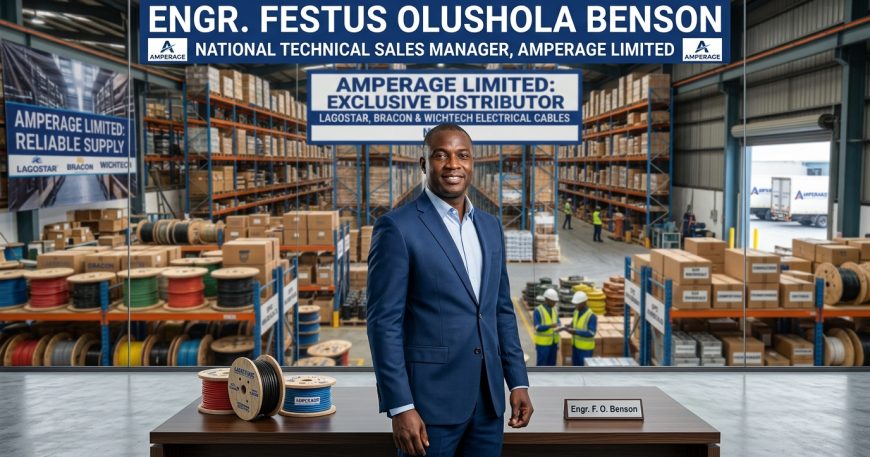
The 2026 Infrastructure Mandate: A Forensic EPC & MEP Engineering Interview
Featuring Engr. Festus Olushola Benson, B.Eng. Electrical & Electronic Engineering, National Technical Sales Manager, Amperage Limited. Interview conducted by Darasimi Ojo and Ayobola Adebowale, Engineering & Infrastructure Review.
Why “Standard” Isn’t Enough Anymore
Darasimi Ojo: Engr. Festus, why is compliance no longer sufficient for infrastructure reliability?
Engr. Festus: Compliance was always meant as a baseline, not a performance guarantee. Infrastructure in Nigeria and West Africa operates under real environmental stress — high ambient temperatures, humidity swings, aggressive soil conditions, and unstable load profiles. A cable that just meets minimum standard can still become a hidden failure point under those conditions.
At Amperage, we try to design for lifecycle survivability, not just installation approval — long-service conductor performance, full conductivity efficiency in line with IEC 60228, and stability under thermal, mechanical, and environmental stress.
Fire Safety and LSZH Cable Systems
Ayobola Adebowale: What’s the most underestimated fire safety risk in electrical infrastructure today?
Engr. Festus: It’s not the flame — it’s toxic emission from conventional insulation. Standard PVC insulation releases hazardous halogen gases when it burns, including hydrogen chloride, which becomes dangerous fast in enclosed spaces.
That’s why we push LSZH (low smoke, zero halogen) cable systems for critical infrastructure — buildings where evacuation time and air quality during a fire genuinely determine outcomes, not just whether the flame is contained.
CAPEX vs. Lifecycle Cost
Darasimi Ojo: How do you justify premium materials in a price-sensitive market?
Engr. Festus: Because procurement decisions get made on upfront cost, but failure shows up in operating cost. A cheaper conductor often means higher resistance, more thermal loss, higher energy use, and faster insulation degradation. The system ends up paying for that “saving” repeatedly over its life.
We try to push clients toward evaluating materials on 15–30 year performance cost, not just the invoice total.
Power Quality and Harmonics
Ayobola Adebowale: What’s the most overlooked electrical risk in modern buildings?
Engr. Festus: Harmonic distortion from non-linear loads. Data centers, LED systems, and VFD-driven motors all introduce harmonics into the network, which can overheat neutral conductors, destabilize voltage, and degrade equipment over time.
We address it with oversized neutral conductor sizing, K-rated system components, and harmonic load assessments (THD evaluation) before design sign-off. Reliable infrastructure today isn’t just about supplying power — it’s about power quality.
Earthing and Lightning Protection
Darasimi Ojo: Is traditional earthing still adequate in a high-lightning-risk region like Nigeria?
Engr. Festus: Not always. Soil resistivity varies a lot across sites, and a basic earth rod can be ineffective where soil conductivity is poor. For higher-risk sites — data centers, hospitals, industrial plants — we recommend soil resistivity testing before design, and where needed, electrolytic earthing systems with corrosion-resistant compounds for a more permanent low-resistance ground.
What Sets Amperage Apart in Procurement
Ayobola Adebowale: What differentiates Amperage from a standard materials trader?
Engr. Festus: We try to operate more like an engineering control point than a trading desk. Materials go through specification verification, manufacturer authentication, BOQ alignment, and lifecycle suitability checks before they’re approved for a project. Every delivery includes Technical Data Sheets, Certificates of Conformity, and batch traceability documentation — so procurement decisions are based on verified data, not assumptions.
Logistics as an Engineering Function
Darasimi Ojo: How do you manage delivery reliability across Nigeria and West Africa?
Engr. Festus: We treat logistics as part of the engineering process, not just transport. That means same-day dispatch for in-stock materials around Lagos, Ogun, and Oyo; a 1–10 working day cycle for factory orders; nationwide coverage across all 36 states; and structured supply capability into West Africa. Distance is a logistics problem to plan around, not a reason a project gets delayed.
Closing Thoughts
Engr. Festus Olushola Benson: Infrastructure failure is rarely sudden — it’s usually the accumulation of weak specification decisions, substandard materials, loose procurement control, and no lifecycle planning. The real question for any project isn’t whether it’s installed correctly today. It’s whether it’s built to survive thirty years of real-world use, not just thirty days of inspection.
Interested in a materials or lifecycle audit for your project? Get in touch with our engineering team →